Advanced Drift Techniques for Top Scores in FR Legends
Basic drifting comes easily after a few hours of practice. Anyone can slide sideways and link corners.
Getting top scores requires entirely different skills – control, consistency, and smart technique separate high scorers from average players.
What this guide covers
Entry control: How you initiate determines everything downstream. Clean entries enable perfect runs. Messy entries doom scores before the first apex.
Angle management: Holding maximum sustainable angle without spinning. Too few score poorly. Too much ends runs instantly.
Line precision: Exact positioning throughout corners. Small errors compound quickly. Perfection demands millimeter awareness.
Transition timing: Smoothness between direction changes. Jerky transitions kill combos. Flow maintains multipliers.
Score optimization: Understanding what judges reward. Many techniques look impressive but score poorly. Focus effort correctly.
How Scoring Works in FR Legends
Understanding scoring mechanics changes everything. You chase points intelligently instead of guessing.
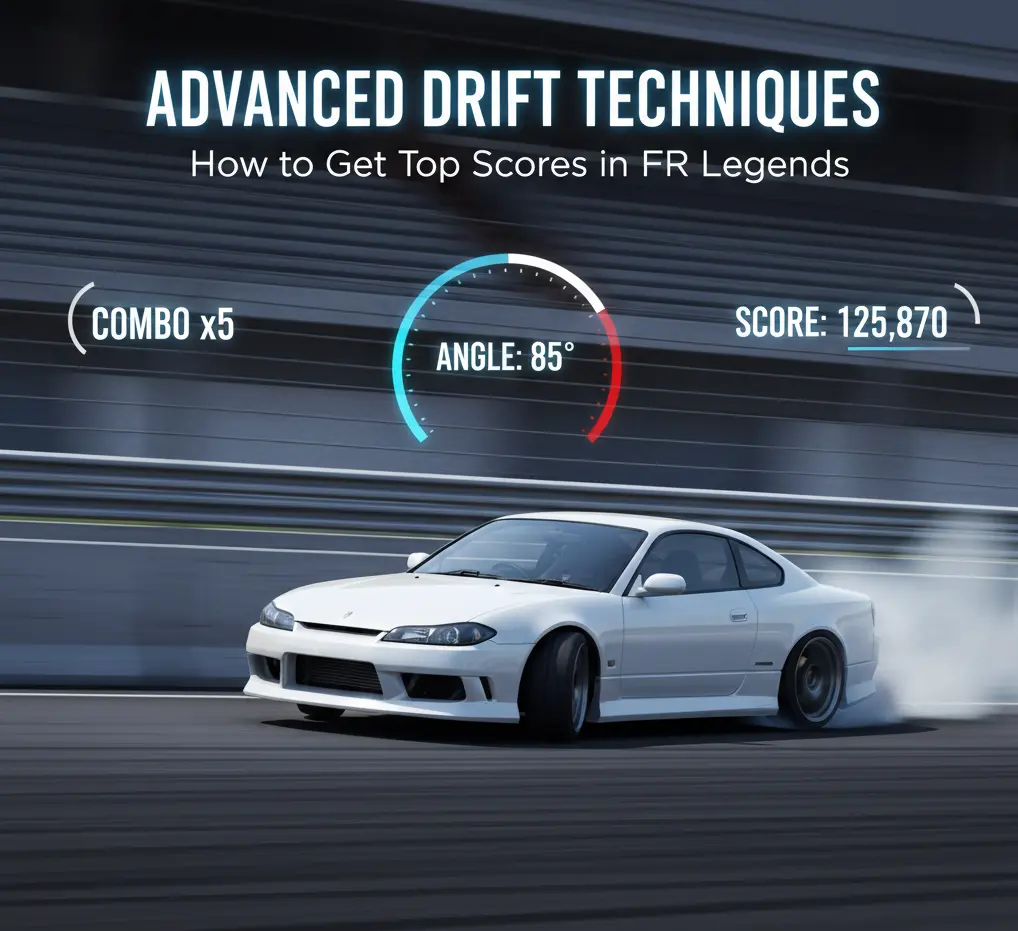
Angle affects points: A steeper angle generates more base points per second. But only a sustainable angle counts. Spinning scores zero.
Speed affects multiplier: Higher velocity through corners multiplies the base score. But excessive speed prevents angle maintenance. Balance matters critically.
Proximity to walls increases score: Closer drift lines add bonus multipliers. Risk increases proportionally. Wall taps end combos instantly.
Consistency maintains combo: Unbroken drift chains multiply total score exponentially. Brief straightening resets everything. Flow beats flash.
Transitions affect flow rating: Smooth direction changes preserve combo multiplier. Harsh inputs reduce the flow score component. Aggression costs points.
Mastering Drift Entry Techniques
The entry method determines the maximum achievable angle and control throughout corners.
Feint Entry (Scandinavian Flick)
Best for tight corners: Quick weight transfer creates rotation before turn-in. You gain angle immediately, without loss of speed.
Steering left before the right corner (or vice versa) loads outside the suspension. Weight shifts create a pendulum effect. The car rotates naturally.
Requires timing: Early feint wastes effect before the corner arrives. Late feint provides insufficient rotation. Practice timing in the same corner repeatedly.
High-angle potential: Aggressive feints generate steep angles instantly. But control difficulty increases proportionally. Master moderate feints first.
Brake Drift Entry
Controlled initiation: Braking mid-turn transfers weight forward. Rear lights and breaks loose predictably. You control exact breakaway timing.
Less dramatic than feint entry. More consistent results. Better for technical tracks demanding precision over style.
Good for beginners moving into advanced style: Predictable behavior builds confidence. You learn angle management without chaos. Natural progression step.
Handbrake Entry
Quick angle creation: Instant rear traction loss. Rotation happens immediately. Good for very tight entries with limited space.
Risk of over-rotation: Too much handbrake spins you completely. Too little wastes the input. Binary nature demands precise calibration.
When to use each:
Feint entries work best on medium-speed corners with approach space. Brake entries suit technical precision sections. Handbrake entries handle only emergency angle needs.
Maintaining High Angle Without Spinning
High angle generates points. But only sustained angle counts. Spinning scores nothing.
Balance throttle input: Part throttle maintains angle smoothly. Full throttle overwhelms rear traction on most setups. Modulation matters constantly.
Feel for the limit. Right before the tires fully break loose. Hold that exact throttle position. Tiny adjustments keep you there.
Avoid full throttle mid-corner: Downhill sections especially. Gravity already reduces rear grip. Adding full power guarantees spinning. Stay conservative.
Use small steering corrections: Large inputs upset the balance dramatically. Micro-adjustments keep the angle without disrupting flow. Smooth hands win.
Keep RPM steady: Constant engine speed provides predictable power delivery. RPM changes create throttle response changes. Stability suffers.
Stay in one gear through linked sections when possible. Shifting mid-combo risks breaking rhythm.
Perfecting Drift Transitions
Transitions between corners make or break high scores. Flow connects individual sections into complete runs.
Weight Transfer Control
Smooth steering reversal: Progressive wheel movement between directions. Not instant lock changes. The car settles naturally through the center.
Feel the weight shift from side to side. Let physics work. Fighting momentum wastes energy and breaks flow.
Avoid snapping the wheel: Harsh inputs shock suspension. The car bounces instead of rotating smoothly. Control degrades instantly.
Professional drivers make steering look effortless. Smooth inputs create that effect. Aggression looks exciting, but scores poorly.
Throttle Feathering
Tap, don’t hold: Brief throttle pulses maintain rotation without overwhelming grip. On-off rhythm keeps the car dancing.
Full throttle commitment works only on specific corner types. Most situations demand modulation. Learn the difference through experimentation.
Maintain rotation without losing grip: You want continuous angle shift without tires fully breaking loose. The edge between drift and spin. Live there.
Timing Between Corners
Do not reset the angle too early: Straightening between sections kills the combo multiplier. Hold a slight angle through transitions when possible.
Even five degrees of drift maintains combo. Full straightening resets everything. Those few degrees mean thousands of points.
Let the car flow naturally: Fighting physics costs control. Working with momentum preserves energy. The car wants to flow. Let it.
Proximity Technique – How to Drift Close to Walls
Wall proximity multiplies the score significantly. But wall contact ends runs instantly. Risk versus reward decision constantly made.
Approach from a wider line: Starting outside gives room for adjustment. You can tighten the line mid-corner if needed. Inside starts leave no options.
Control rear swing: Rear end moves outward during drift. Account for this in positioning. Aim inward rather than feel correct initially.
Avoid panic steering: Seeing a wall approach triggers instinctive overcorrection. This makes contact more likely, not less. Trust your line.
Practice on wider tracks first: Build proximity comfort without immediate danger. Tsukuba works well. Then progress to tighter venues.
Wall awareness develops gradually. You cannot force it through willpower alone. Time and repetition build unconscious calibration.
Maximizing Drift Combo and Multiplier
The combo multiplier grows exponentially as unbroken chains increase. One mistake resets hours of potential scoring.
Keep the drift chain continuous: Even shallow angle between corners maintains combo. Brief straightening kills everything. Prioritize connection over perfection.
Avoid straightening wheels: Steering needs constant input during combos. Zero angle, even momentarily, resets the multiplier. Stay active always.
Do not drop speed suddenly: Velocity multiplier factors constantly. A major speed loss reduces the score even when the angle is maintained. Smooth momentum management.
Use medium-horsepower builds for stability: the 400-450 HP range strikes a balance between control and adequate power. Too much makes consistency impossible. Too few limits on angle capability.
Consistency beats peak performance. Reliable 85% execution scores higher than occasional 100% mixed with failures.
Car Setup Adjustments for Advanced Drifting
The setup enables technique execution. The wrong setup makes perfect driving impossible.
Horsepower Range for High Score Runs
400 to 500 HP ideal: Enough power for angle authority. Not so much that the throttle becomes too sensitive. Sweet spot for control.
Below 400 HP, sustained angle capability is limited. Above 500 HP makes consistency very difficult. Stay in range for scoring.
Front vs Rear Grip Balance
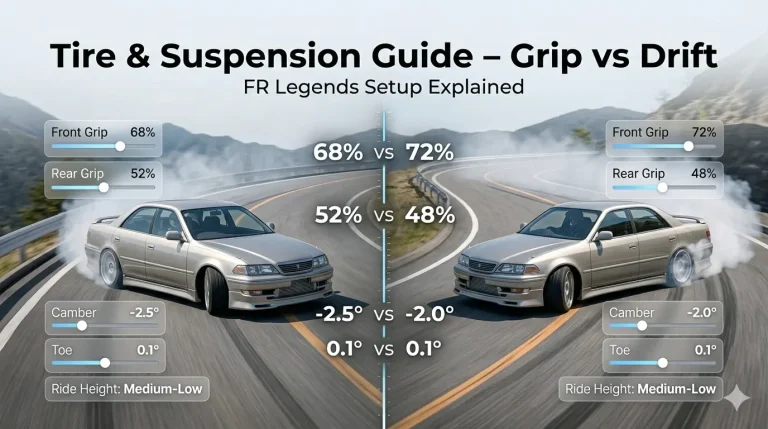
Slightly lower rear grip: 48-52% rear creates controllable rotation. Too loose makes the throttle binary. Too grippy prevents angle.
Stable front grip: 65-70% front provides steering confidence. You point accurately without understeer concerns. Precision demands this.
Suspension Tweaks
Balanced camber: Front -2.5, Rear -2.0 degrees works broadly. Too much makes car twitchy. Too little reduces response.
Slightly softer rear: Helps weight transfer communication. You feel the grip breaking before it fully releases. Warning saves runs.
Keep changes incremental. Test each adjustment individually. Changing multiple variables simultaneously teaches nothing.
Track Selection for High Score Practice
Different tracks teach different scoring components.
Tsukuba (technical): Precision line practice. Tight sections demand exact positioning. Mistakes show immediately.
Ebisu Touge (flow): Continuous corner linking. Teaches transition smoothness. Combo maintenance focus.
Suzuka (speed balance): Mix of fast and technical. Tests complete skill set. Good benchmark track.
Drift Playground (transitions): Isolated technique practice. No track pressure. Focus purely on transition timing.
Rotate between tracks. Each teaches something others cannot. Complete skill development needs variety.
Common Advanced Mistakes That Kill Your Score
Even experienced players repeat these errors.
Over-rotating on entry: Too much initial angle forces correction mid-corner. This breaks the flow and reduces the score. Conservative entries work better.
Excess throttle mid-corner: Feels exciting but overwhelms grip. You fight the car constantly. Smoothness scores higher than drama.
Wrong gear usage: Staying in gear too long hits the limiter. Shifting too early drops RPM below powerband. Either kills the flow.
Ignoring track layout: Forcing the same technique everywhere fails. Some corners need different approaches. Adapt to conditions.
Focusing on the angle of flow: The maximum angle is visually impressive. But broken flow scores poorly. Connected moderate-angle beats disconnected extreme-angle.
Training Routine to Improve Faster
Systematic practice produces faster improvement than random attempts.
Practice one corner repeatedly: Master single sections before linking. Perfection in isolation transfers to full runs. Build systematically.
Use replay mode: Watch runs from an external view. Mistakes become obvious. You see what feels right but looks wrong.
Adjust setup gradually: Change one variable at a time. Note the effect clearly. Random changes teach nothing about cause and effect.
Increase horsepower slowly: Add 20-30 HP increments only after mastering the current power level. Rushing creates bad habits, compensating for excess power.
Focus on consistency before aggression: Ten runs scoring 85% beats one perfect run with nine failures. Reliability enables improvement.
Even practicing on FR Legends iOS or testing new cars demands this same systematic approach. Fundamentals transfer across all versions.
Visual customization through livery codes helps motivation, but changes nothing about the scoring technique. Focus effort on controlling development primarily.
Are Advanced Techniques Necessary for Multiplayer Battles?
Competition demands higher skill levels than solo play.
Yes for competitive rooms: Top players execute these techniques unconsciously. You cannot compete without matching skill level. The gap becomes obvious instantly.
Especially proximity and smooth transitions: Battle scoring places a heavy weight on these. Aggressive angle alone loses to smooth proximity drifting. Judges reward control.
Clean driving often beats aggressive angle: Tandem runs especially. Matching opponent smoothly scores better than flashy independence. Consistency wins battles.
Advanced techniques matter less in casual lobbies. But serious competition requires mastery. No shortcuts exist at high levels.
The base FR Legends teaches these fundamentals best. Even FR Legends 2 will build on this same foundation when released. Core principles remain constant.
Final Thoughts – Becoming a High-Score Drift Player
Top-scoring demands specific mindset shifts from casual play.
Scoring is about control, not chaos: Flashy style impresses spectators. Controlled precision impresses judges. Focus determines results.
Smoothness over aggression: Harsh inputs break flow. Gentle inputs maintain momentum. Physics rewards subtlety consistently.
Consistency over risk: Reliable execution beats occasional perfection. Build sustainable performance. Spectacular failures score zero.
Advanced drifting feels different than casual play. Less exciting moment-to-moment. More satisfying when scores reflect mastery. Trade-off worth making for great improvement.
FAQ’s:
How do I increase my drift score?
Maintain unbroken combos through smoothness. Increase wall proximity gradually. Hold a higher sustainable angle without spinning. Keep speed up through corners. Focus on flow over individual corner perfection.
What HP is best for high scoring?
400-500 HP range balances angle capability with control. Below 400 limits sustained angle. Above 500 makes consistency very difficult. Stay in the sweet spot for reliable high scores.
Why do I lose combo?
Brief wheel straightening between corners. Excessive speed loss during transitions. Spinning or wall contact, obviously. Harsh inputs are breaking the flow rating. Maintain a slight angle always during linked sections.
How do I stop spinning mid-drift?
Reduce throttle input mid-corner. Avoid full throttle on downhill sections. Use smaller steering corrections. Keep RPM steady instead of fluctuating. Lower rear tire grip slightly if spinning persists.
Which track is best for score practice?
Tsukuba for precision technique. Ebisu Touge for flow development. Suzuka for complete skill testing. Drift Playground for isolated transition practice. Rotate between all four for balanced improvement.