Touge vs Circuit Tracks in FR Legends: Which Is Better?

FR Legends is built around two distinct track styles, and they teach completely different skills. Touge tracks push precision and technical control. Circuit tracks build consistency and rhythm. Neither is objectively better. The right choice depends entirely on what you are trying to improve.
Most players drift the same track type on repeat without realising it is limiting their development. Understanding the difference between touge and circuit layouts changes how you approach practice. The FR Legends Drift Tracks Guide covers the full track list, but this article focuses specifically on how these two track styles compare and which one belongs in your rotation right now.
What Are Touge Tracks in FR Legends?
Touge tracks are mountain road-style layouts. They feature elevation changes, tight switchbacks, narrow road widths, and limited recovery space when a corner goes wrong. The driving style they demand is precision-focused. Every entry angle and throttle input matters more than it does on wider tracks.
These layouts replicate the feel of real Japanese mountain passes. Corners link tightly together, so a mistake in one section carries into the next. There is no wide runoff to save a bad entry. Hakone Turnpike is the most recognised touge-style track in FR Legends and a good reference point for what this category demands.
The core skill touge tracks test is weight transfer. Elevation changes shift your car’s balance mid-corner in ways flat tracks never do. Players who spend time on touge layouts develop a sensitivity to how their car moves that is difficult to build anywhere else.
What Are Circuit Tracks in FR Legends?
Circuit tracks are wider, flatter layouts with more predictable corner sequences. They give players more room to experiment, repeat runs cleanly, and build consistent lines without the pressure of narrow road edges.
These tracks are designed around flow. Corners are spaced to allow natural transitions, and the layout repeats in a way that makes comparing runs straightforward. That repeatability is what makes circuit tracks excellent for consistent practice; you can run the same section twenty times and directly measure your improvement.
Gunsai-style layouts are a strong example of the circuit category in FR Legends. Their structured corner design rewards players who focus on linking smooth transitions and building drift rhythm across multiple sections.
Touge vs Circuit: Key Differences
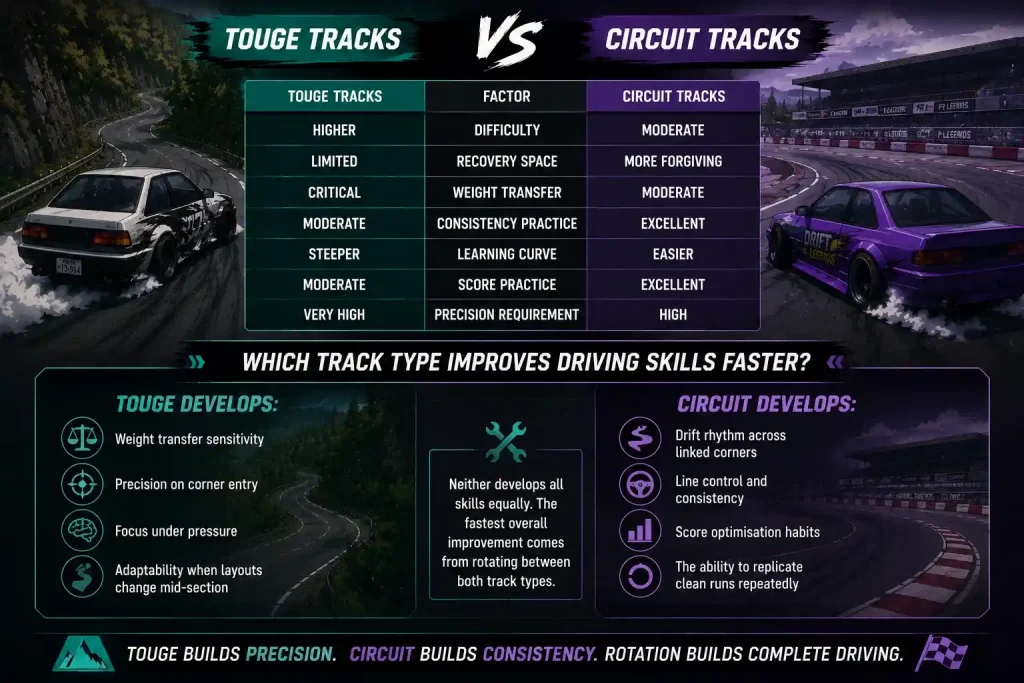
| Factor | Touge Tracks | Circuit Tracks |
| Difficulty | Higher | Moderate |
| Recovery space | Limited | More forgiving |
| Weight transfer | Critical | Moderate |
| Consistency practice | Moderate | Excellent |
| Learning curve | Steeper | Easier |
| Score practice | Moderate | Excellent |
| Precision requirement | Very high | High |
Which Track Type Improves Driving Skills Faster?
The answer depends on which skills you are targeting.
Touge develops:
- Weight transfer sensitivity
- Precision on corner entry
- Focus under pressure
- Adaptability when layouts change mid-section
Circuit develops:
- Drift rhythm across linked corners
- Line control and consistency
- Score optimisation habits
- The ability to replicate clean runs repeatedly
Neither develops all skills equally. Players who only run touge tracks tend to be precise but inconsistent on open layouts. Players who only run circuits tend to be smooth but struggle when technical precision is required. The fastest overall improvement comes from rotating between both.
Best Track Type for Beginners
Beginners progress faster on circuit-style layouts. The wider roads and more forgiving runoff give new players room to make mistakes without losing the run entirely. That space is critical early on. It lets you focus on throttle control and angle without worrying about wall contact on every corner.
Circuit tracks also make it easier to repeat runs cleanly. Repetition is how fundamentals get built, and a track that resets cleanly after a mistake supports that process better than a tight touge that punishes every error immediately.
Players who are unsure where to start can also review the best tracks to practice drifting in FR Legends before choosing between touge and circuit layouts. Ebisu-style layouts are a strong starting point for this stage. Their open structure and well-spaced corners let beginners build drift rhythm and line awareness before moving to more demanding layouts.
Best Track Type for Intermediate Players
Intermediate players, those who can run clean laps on circuit tracks but feel like their improvement has plateaued, are exactly the players touge tracks are designed for.
Technical touge layouts expose the habits that comfortable circuit practice builds and hides. Sloppy entry angles that work on wide circuits get punished immediately on narrow mountain roads. Weight transfer errors that do not matter on flat layouts cause loss of control on elevation changes.
Moving to Hakone Turnpike at this stage is a common step for players who want to push past intermediate-level consistency into genuine technical control. The difficulty jump is real, but the skills it forces you to develop transfer directly back to circuit tracks and raise your ceiling there, too.
Best Track Type for Competitive Players
Advanced players do not choose between track types; they rotate through both deliberately.
Touge keeps precision sharp. Circuit keeps consistency and scoring habits dialled. A player who only practises one style will eventually hit a ceiling that the other type breaks through. Competitive players understand that each track category develops a different strength, and both are needed to perform at a high level across varied conditions.
The practical approach is simple: use circuit tracks to optimise your scoring runs and use touge tracks to stress-test your technique. What breaks on a touge needs fixing. What flows cleanly on a circuit is working.
Common Mistakes When Choosing Tracks
- Staying on one track forever and calling it practice when it is actually just repetition
- Starting on difficult touge layouts before circuit fundamentals are solid
- Ignoring consistency practice because circuits feel less exciting than technical mountain roads
- Choosing tracks based only on difficulty rather than on what skill gap they address
- Treating scoring runs and technique practice as the same session
So, Which Is Better?
Choose touge tracks if:
- You want to develop technical precision
- Your entries feel inconsistent under pressure
- You are ready to have your weaknesses exposed quickly
- You enjoy layouts that demand full focus on every corner
Choose circuit tracks if:
- You are still building core drifting fundamentals
- Your scores are inconsistent, and you want to fix your rhythm
- You want a controlled environment to test tuning changes
- You are working on linking multiple corners cleanly
Final Thoughts
Touge and circuit tracks in FR Legends are tools, not opposites. Touge builds the precision that circuit practice cannot force. Circuit builds the consistency that tough practice cannot develop alone. The best players are comfortable on both because both gaps in their game have been addressed.
If you are not sure where to start or want a clear picture of every available layout before deciding, the FR Legends Drift Tracks Guide maps out the full track ecosystem with the context you need to build a smarter practice rotation.
FAQs
Are touge tracks harder than circuit tracks in FR Legends?
Generally yes. Touge tracks have narrower roads, elevation changes, and less recovery space. The margin for error is smaller, which makes them more technically demanding than most circuit-style layouts.
Which track type is better for improving drift scores?
Circuit tracks. Their wider layouts and repeatable corner sequences make it easier to build consistent scoring runs. Touge tracks are better for technique development than score optimisation.
Can beginners use touge tracks in FR Legends?
Beginners can try them, but most will progress faster starting on circuit-style tracks. Touge layouts punish mistakes immediately, and the steeper learning curve can build bad habits before fundamentals are solid.
Do professional FR Legends players use both track types?
Advanced players rotate between both deliberately. Touge keeps precision sharp. Circuit keeps scoring consistency,y and drift rhythm dialled. Relying on only one type limits long-term development.
What is the main skill difference between touge and circuit drifting?
Touge drifting trains, weight transfer sensitivity and precision under pressure. Circuit drifting trains rhythm, line control, and the ability to replicate clean runs. Both skill sets are needed to become a well-rounded driver.
Which track style suits a car setup better, touge or circuit?
Different setups suit different layouts. Softer suspension and tighter gear ratios tend to work better on technical touge tracks. Stiffer, higher-speed setups suit wide circuit layouts. Testing both is the fastest way to understand your car’s actual strengths.
Is Hakone a touge track or a circuit track?
Hakone is a touge-style track. Its elevation changes, narrow roads, technical corner sequences, and mountain-pass design place it firmly in the touge category rather than the circuit category. It is one of the most recognised examples of touge driving in FR Legends.