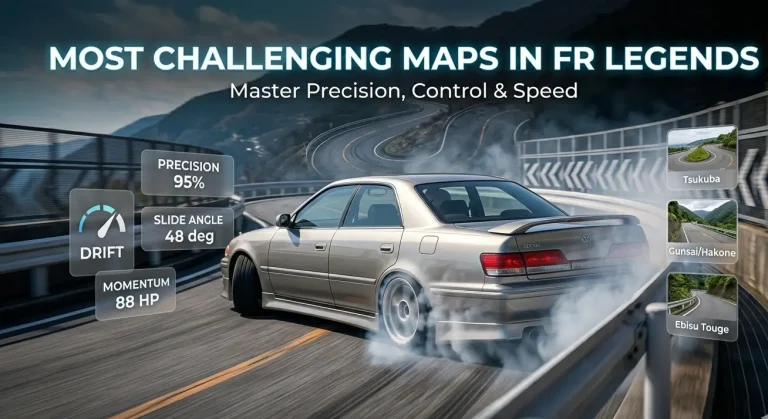
Gunsai Style Layouts in FR Legends: Why Skilled Players Love Them

Gunsai-style layouts are circuit-inspired tracks built around consistent, repeatable corner sequences rather than chaos or tandem proximity. Score-focused drivers favor them because clean execution matters more than raw speed or aggression.
This guide covers what defines a Gunsai-style layout, why experienced players return to them, and how to drive one effectively.
What Are Gunsai Style Layouts?
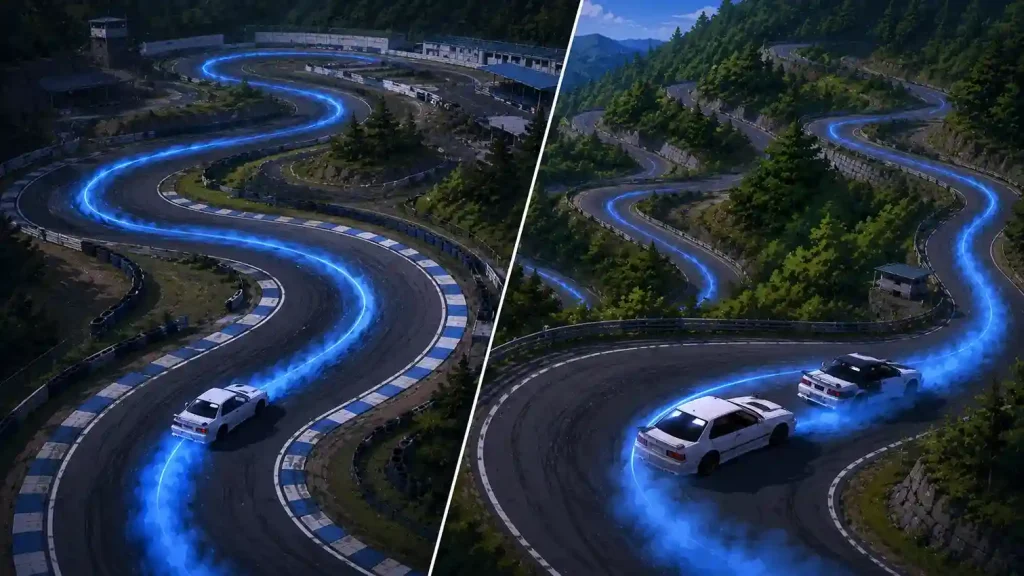
Gunsai-style layouts are circuit-inspired tracks designed around consistent corner sequences that reward clean, repeatable execution.
The design favors technical but predictable corners over unpredictable elevation changes on touge roads or the wide, flowing sections built for tandem driving. Each sequence is meant to be learned and repeated precisely, making these layouts a natural fit for scoring rather than chasing variety.
Why Players Like Gunsai Style Layouts
Players like Gunsai-style layouts because the predictable flow makes it possible to refine a single line until it’s genuinely clean. This mirrors the precision-focused driving culture rooted in Japanese technical drift and mountain-road environments, where consistency earns more respect than raw aggression.
That predictability translates into score improvement, since consistent corner sequences reward polished execution rather than one lucky run. The layout also functions as consistency training, since players who can’t repeat a clean line get exposed quickly. For competitive players, that repeatability makes Gunsai-style layouts a reliable benchmark for measuring improvement.
Skills You Can Improve on Gunsai Layouts
Gunsai-style layouts are effective for refining the technical fundamentals on which score-focused drifting depends.
Drift consistency improves directly, since the layout punishes any run that isn’t repeatable. Corner linking is tested constantly, since these layouts string corners together in sequences that demand smooth transitions rather than isolated drifts.
Precision driving sharpens here, since there’s little room for sloppy inputs to go unnoticed. Line control is the long-term payoff, since mastering a Gunsai-style layout typically carries that discipline into other technical tracks, including Hakone Turnpike.
How Gunsai Style Layouts Differ from Other Track Types
| Factor | Gunsai-Style | Ebisu-Style | Touge Roads |
| Difficulty | Moderate-High | Moderate-High | High |
| Tandem Suitability | Low | Built for tandem | Limited |
| Precision Requirements | Very High | Moderate | High |
| Learning Curve | Moderate, rewards repetition | Moderate | Steep |
| Score Potential | Very High | Moderate | Moderate |
Gunsai-style layouts stand out for prioritizing precision and score potential over the tandem focus of Ebisu-style layouts or the unpredictable demands of touge.
Best Cars for Gunsai Style Layouts
Balanced drift builds generally perform best here, since consistency matters more than raw power. The top drift builds guide covers setups suited to this kind of repeatable, technical driving.
Stable chassis options outperform twitchy, high-angle builds, since a car that behaves predictably through the same sequence every run is more valuable than one capable of extreme angle but inconsistent recovery.
Recommended Driving Approach
Smooth inputs matter more here than aggressive corrections, since the layout punishes anything that disrupts a clean, repeatable line.
Maintaining rhythm across the full sequence is more valuable than nailing one corner perfectly and losing the next. Consistent line choice, repeated every lap, separates players who score well from those who don’t.
Common Mistakes in Gunsai Style Layouts
- Overdriving corners. Pushing for maximum angle on every corner breaks the rhythm these layouts are built around.
- Chasing speed over consistency. Speed without a repeatable line rarely scores well, since clean execution matters most.
- Poor line selection. A line that works for one corner but compromises the next undermines the entire sequence.
- Aggressive steering corrections. Overcorrecting disrupts the smooth inputs these layouts reward. Small adjustments work better.
Who Should Drive Gunsai Style Layouts?
Beginners can drive Gunsai-style layouts, but they’re more valuable once basic drift control is in place, since the focus is refinement rather than fundamentals.
Intermediate players benefit significantly, since these layouts build the consistency needed before tackling more demanding tracks. Advanced players use them for score optimization, since the repeatable design makes it possible to measure improvement run after run.
Gunsai vs Ebisu: Which Style Suits You?
Gunsai-style layouts suit precision, consistency, and score-oriented practice. Ebisu-style layouts suit tandem practice, technical flow, and driver interaction.
Neither is objectively better. The right choice depends on whether your goal is refining a solo line for score, or developing the reactive skills tandem drifting demands.
Final Thoughts
Gunsai-style layouts remain popular because they isolate the skills that score-focused drifting depends on: consistency, precision, and clean corner linking. These tracks reward players who can repeat the same clean line over and over.
Players serious about score improvement will get more from consistent time here than almost any other track type. For a broader look at the roster, the FR Legends Drift Tracks Guide is the natural next stop.
FAQs
Are Gunsai layouts good for beginners?
They’re usable for beginners, but players get more value once basic drift control is in place.
What makes Gunsai layouts different?
Consistent, repeatable corner sequences set them apart, prioritizing precision and score potential over tandem suitability.
Which cars work best on Gunsai-style tracks?
Balanced drift builds with stable, predictable handling work best, since consistency matters more than power.
Are Gunsai layouts harder than circuits?
They’re comparable to standard circuits in difficulty, but demand higher precision since scoring depends on repeatable execution.
Do Gunsai layouts improve drift scores?
Yes. The consistent corner sequences suit refining the clean, repeatable lines that scoring systems reward.
What skill improves most on Gunsai-style layouts?
Drift consistency improves the most, since the layout exposes any run that isn’t repeatable almost immediately.
Are Gunsai layouts better for solo or tandem drifting?
They’re built for solo, score-focused driving, unlike Ebisu-style layouts, which prioritize tandem practice.
Do Gunsai layouts require special tuning? Not special tuning, but setups built for stability and predictable handling outperform aggressive builds here.
Are Gunsai-style layouts based on the real Gunsai Touge?
Yes, loosely. They’re inspired by the reputation and precision-focused driving style associated with Gunsai Touge in Japan, though the exact implementation varies by game and map creator.