Ebisu Style Layouts in FR Legends: Track Guide for Tandem Drifting

Ebisu-style layouts are tracks built around flowing, multi-corner sections designed for close, sustained tandem drifting rather than isolated single-car runs. Experienced drifters gravitate toward them because they reward driving with another car in mind, not just driving fast alone.
This guide covers what defines an Ebisu-style layout, why players keep returning to them, and how to approach driving one.
What Are Ebisu Style Layouts?
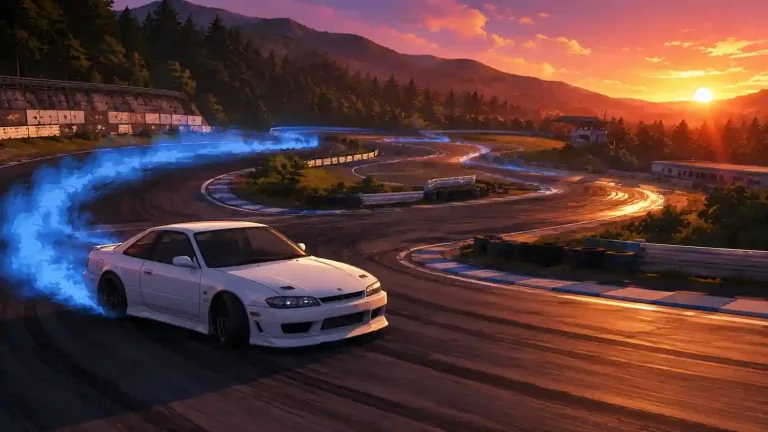
Ebisu-style layouts blend flowing corners with technical sections, built to support two cars drifting closely together rather than racing for the fastest lap.
The layout philosophy favors wide, connected corners over isolated technical challenges. Instead of a single hairpin demanding precision in isolation, these layouts string corners together so a following car can read and react to the lead car’s line.
Why Players Like Ebisu Style Layouts
Players like Ebisu-style layouts because they combine variety, tandem opportunity, and technical challenge in one run. These layouts are associated with tandem-focused driving culture popular in Japanese drifting communities, where proximity, flow, and coordination earn more respect than pure speed.
The mix of corner types keeps a lap from feeling repetitive, unlike circuits built around one dominant corner shape. Where Hakone Turnpike rewards precision and elevation management in isolation, Ebisu-style layouts reward flow and rhythm shared between two cars.
Skills You Can Improve on Ebisu Layouts
Ebisu-style layouts are effective for developing tandem-specific skills that solo-focused tracks don’t really test.
Following another driver’s line becomes a real skill here, since wide, connected corners give a following car room to read and react rather than copy a fixed line. Tandem consistency improves naturally, since holding position through linked corners is harder than nailing one drift.
Transition control gets tested constantly, since flowing layouts demand smooth weight shifts rather than sharp transitions found on tighter tracks. Drift rhythm is the long-term payoff, teaching players to maintain flow across a sequence instead of resetting after every corner.
How Ebisu Style Layouts Differ from Standard Circuits
| Factor | Ebisu-Style Layouts | Standard Circuits |
| Track Flow | Wide, connected, flowing | Mixed, more isolated corners |
| Technical Difficulty | Moderate to high | Varies by circuit |
| Tandem Suitability | Built for tandem driving | Usable but not optimized |
| Learning Curve | Moderate, rewards repetition | Lower for solo driving |
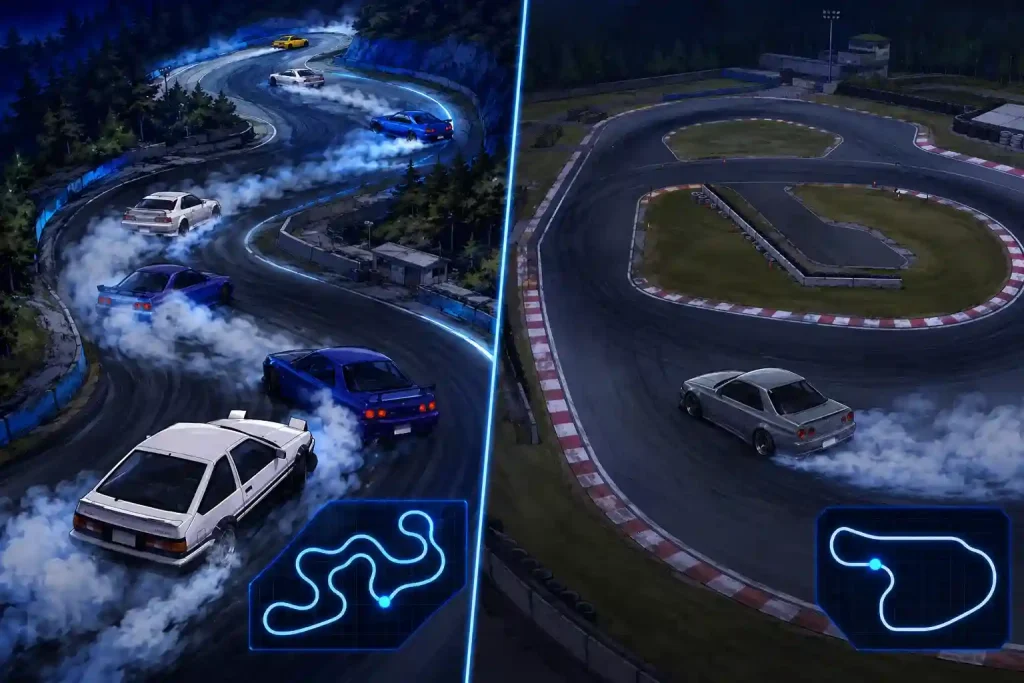
Standard circuits can be used for tandem practice, but Ebisu-style layouts are built around it from the ground up, showing how forgiving the corners feel when a second car follows closely.
Best Cars for Ebisu Style Layouts
Balanced JDM builds tend to work best here, since flowing corner sequences favor predictable handling over outright aggression. The JDM car roster covers several platforms suited to this kind of driving.
Predictable handling outperforms aggressive, twitchy builds here, since tandem driving rewards a car that behaves the same way every time through a corner. Tandem-focused builds, tuned for stability over maximum angle, give the following car a more readable line to chase. The top drift build guide is a useful reference for choosing a platform.
Recommended Driving Approach
Smooth transitions matter more here than aggressive entries, since flowing corner sequences punish abrupt inputs more than technical tracks do.
Maintaining proximity in tandem runs means matching speed and line rather than closing distance aggressively. Reading track flow ahead of time helps maintain rhythm. Avoiding over-aggression is the biggest adjustment players coming from technical tracks need to make.
Common Mistakes in Ebisu Style Layouts
- Chasing speed instead of flow. Treating these layouts like a high-speed circuit breaks the rhythm they’re built around.
- Following too closely in tandem. Closing the gap too aggressively leads to collisions rather than clean runs.
- Overcorrecting. Flowing layouts punish large corrections more than tight tracks do, since there’s less room to recover momentum.
- Using unstable setups. A twitchy, high-angle setup makes it harder to hold a consistent line for tandem partners to follow.
Who Should Drive Ebisu Style Layouts?
Beginners can drive Ebisu-style layouts, though the tandem-focused design means they’ll get more value once basic transition control is in place.
Intermediate players benefit significantly, since these layouts effectively develop tandem-specific skills without an advanced setup. Advanced players use them to refine tandem precision and rhythm, since flowing sequences expose inconsistencies that isolated technical tracks won’t reveal.
Final Thoughts
Ebisu-style layouts remain popular because they’re built around a kind of driving most other tracks don’t prioritize: sustained, connected tandem work. The skills they develop carry directly into competitive and multiplayer drifting.
Players focused on tandem improvement will get more from consistent time here than almost any other track. For a broader look at the roster, the FR Legends Drift Tracks Guide is the natural next stop.
FAQs
Are Ebisu layouts good for beginners?
They’re usable for beginners, but players get more value once basic transition control is in place.
Why are Ebisu layouts popular for tandem drifting?
The wide, connected corners give a following car room to read and react, which standard circuits don’t prioritize.
What car works best on Ebisu-style tracks?
Balanced JDM builds with predictable handling work best, since consistency matters more than aggression in tandem driving.
Are Ebisu layouts harder than standard circuits?
They’re moderately technical, but the real difficulty comes from maintaining flow and tandem consistency, not corner difficulty alone.
What skill improves most on Ebisu layouts?
Following another driver’s line improves the most, since the layout is built to support that kind of reactive driving.
Do Ebisu layouts require special tuning?
Not special, but setups prioritizing stability and predictable handling generally perform better than aggressive, twitchy builds.
Are Ebisu layouts better for tandem or solo drifting?
They’re built primarily for tandem drifting, though solo drivers can still use them to practice flow and transition control.
Are Ebisu-style layouts based on the real Ebisu Circuit?
Yes, loosely. They’re inspired by the design philosophy and tandem-focused culture associated with Japan’s famous Ebisu Circuit, though the exact implementation varies by game or map creator.