Custom Maps in FR Legends: Community Tracks Worth Exploring
Custom maps are community-created tracks that go beyond what FR Legends ships with. They add new roads, layouts, and environments that the original developers never built.
After hundreds of hours on the standard circuit list, every corner becomes muscle memory. Custom maps in FR Legends solve that by dropping players into layouts they have never driven before, and the community has been building them for years.
What Are Custom Maps in FR Legends?
Custom maps are tracks built by the FR Legends modding community, not the official developers. Players design these layouts from scratch using modding tools, then share them through forums, Discord servers, and trusted modding sites. Many are distributed as part of FR Legends map mod packs, which bundle multiple custom tracks into a single install.
These maps range from single-corner practice zones to full multi-section mountain passes. Some recreate real Japanese roads. Others are completely original designs that no official drifting game has ever offered.
The key difference from standard FR Legends drift tracks is that custom maps are not limited by the developer’s roadmap. If someone in the community wants a narrow touge with six consecutive hairpins, they build it.
Why Players Use Custom Maps
The main reason is variety. After enough sessions on the stock list, players have driven every line on every corner. Custom tracks in FR Legends provide fresh layouts without switching to a different game.
Beyond variety, custom maps expose weaknesses that familiar stock tracks hide. A tight touge with blind crests forces different road-reading than Ebisu’s open lots. A narrow circuit with no runoff punishes entries that wider stock tracks forgive.
Community creativity is another factor. The best custom layouts come from players with deep drifting knowledge. Their corner sequencing, elevation changes, and road widths are intentional, not random, which is what separates quality community maps from throwaway experiments.
Best Types of Custom Maps Worth Trying
Touge Custom Maps
Mountain pass layouts with tight switchbacks, elevation changes, and guardrails. These are the most popular custom map categories in the community. They reward smooth, controlled drifting and punish brute-force entries. Players use them to build precision. The kind of car control that carries over to every other layout. If you enjoy Hakone Turnpike, touge custom maps extend that experience with different corner combinations.
Circuit Custom Maps
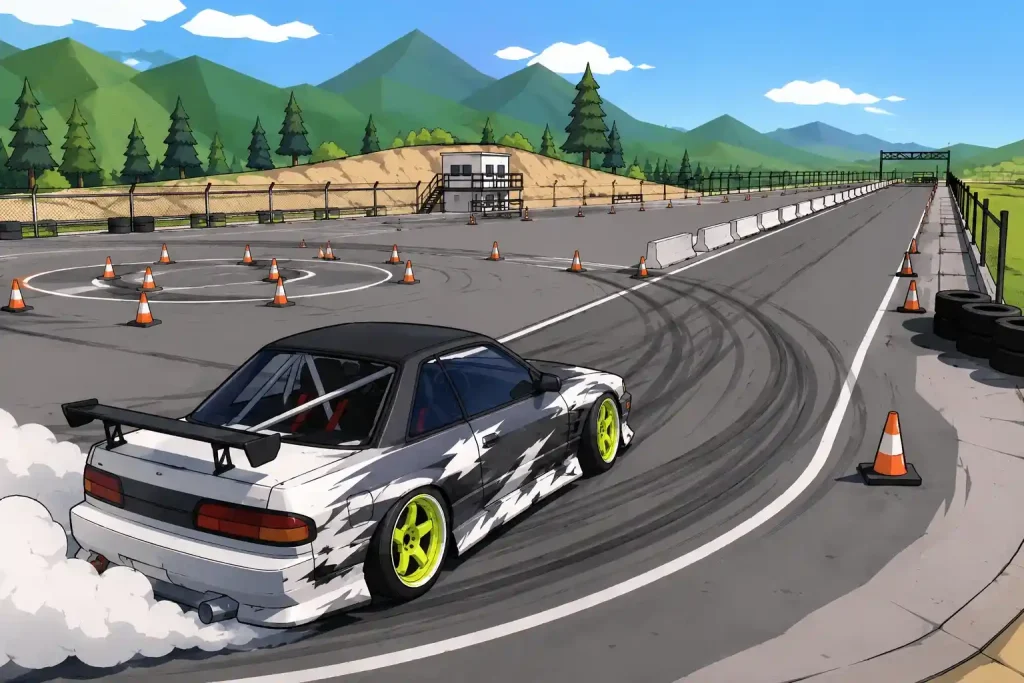
Flat, wide tracks built for high-speed entries and linked long drifts. These suit players are developing consistency across multiple sections without elevation variables. The open style is similar to Ebisu-style layouts but with original shapes that require building new lines from scratch rather than reusing memorised ones. Some community creators also build layouts inspired by Gunsai-style precision driving, favouring technical flow over raw speed.
Tandem Custom Maps
Layouts specifically designed for two-car drifting. Wide enough for side-by-side runs, with predictable corner sequencing that lets lead and chase drivers coordinate. These maps are popular in community events because their design rewards communication and consistency over individual style. They also build the kind of speed and angle control that improves solo sessions, too.
Training Maps
Isolated sections, single corners, skidpads, long straights with a tight entry at the end. Advanced players use these to drill one specific technique without running a full layout every session. Pairing a training map with a dialled top drift build gives you a controlled environment to validate setup changes before committing to full tracks.
What Makes a Good Custom Map?
Quality custom maps share a few consistent traits. Corner exits flow naturally into the next entry. Road width stays consistent, so the layout itself is not fighting the player. Multiple driving lines exist through each section, which is what gives a map replay value beyond the first few sessions.
The maps that stay relevant in the community for years tend to have one more quality: they were tested by multiple drivers before release. A single creator’s blind spots get filtered out when a layout goes through community feedback. Maps released without testing usually disappear within a few months.
How Custom Maps Differ from Standard Tracks
| Feature | Standard Tracks | Custom Maps |
| Variety | Fixed developer library | Hundreds of community creations |
| Quality consistency | Polished and tested | Varies by creator |
| Learning curve | Well-documented lines | You build the lines yourself |
| Creativity | Conservative designs | Experimental and unique |
| Replay value | Decreases over time | Constantly expanding |
Custom Maps vs Hidden Maps
| Type | What It Means |
| Custom Maps | New tracks built by the community from scratch |
| Hidden Maps | Lesser-known content already in mod packs that most players overlook |
Custom maps are new content. Hidden maps in FR Legends are existing content that most players never discover. Both add variety but serve different purposes.
Potential Drawbacks
Not every custom map delivers. Some have clipping issues, invisible walls, or corners that feel unfinished. There is no quality control process, so a promising-looking map can perform poorly.
Compatibility is another real concern. Some custom layouts only work with specific mod versions. Always check version requirements and back up save data before installing anything new.
Who Should Use Custom Maps?
Beginners should build fundamentals on stock tracks first. Throttle control, angle, and transitions need a forgiving environment not the unpredictability of community layouts.
Intermediate players benefit the most. Consistent stock-track scores but stalled improvement is the exact signal that custom maps are worth exploring. They expose the habits that familiar layouts have been hiding.
Advanced players use custom tracks to stay sharp and maintain the adaptability that solid drift technique requires when conditions change.
Final Thoughts
Custom maps in FR Legends matter long-term because the stock track list has a ceiling. Once a player has driven every official layout to the point of pattern recall, improvement stops without new inputs. Community-created tracks provide those inputs indefinitely.
They also fit into a clear progression: master stock tracks, dial in setups, then use custom maps to adapt those skills to unfamiliar conditions. The FR Legends Drift Tracks Guide covers the full official track ecosystem and is the right starting point before stepping into community layouts.
FAQs
Are custom maps safe to use?
Most custom maps from established community sources are safe. The risk comes from unknown or untrusted sites. Stick to well-known FR Legends modding communities and scan files before installing.
Do custom maps change the game’s physics?
No. Custom maps only change the track layout and environment. Car handling, drift physics, and tuning settings stay identical to stock tracks.
Are custom maps harder than standard tracks?
It depends on the map. Some are deliberately harder with tighter corners and no runoff. Others are wider and more forgiving than stock. Difficulty varies by creator and intent.
Can beginners use custom maps?
Beginners can try them, but learning the basics on stock tracks first is better. Custom maps often lack the gradual difficulty curve that official tracks provide.
What makes a good custom map?
Consistent road width, natural corner flow, multiple driving lines, and fair difficulty. The best maps were designed by players who actually drive them, not just built for visual appeal.
What’s the difference between custom maps and map mods?
Custom maps are the track files themselves, the actual layouts players drive. Map mods are the packaged files that deliver those tracks to your game. Most custom maps are distributed inside map mod packs, which is why the terms get used interchangeably, but the map is the content, and the mod is the delivery method.
Are custom maps based on real Japanese roads?
Some are. Many community creators recreate famous Japanese touge roads, drift venues, and mountain passes from reference footage. Others are entirely original. The quality of real-world recreations varies significantly by creator; some are impressively accurate, others are loose interpretations with different corner geometry.