FR Legends Gear Ratios: Proven Setups for High Drift Scores [v0.3.6]
Getting your fr legends gear ratios right can make or break your drift runs. Poor gearing leads to inconsistent entries, unstable angles, and frustrating score drops mid-corner.
The secret isn’t copying random setups online. It’s following a simple method: pick your main drive gear first, set your final drive to match, then fine-tune individual ratios.
This guide gives you track-specific presets and power band adjustments that actually work. You’ll learn to avoid limiter bounce, eliminate bog-downs, and build smooth transitions that keep your scores climbing consistently.
Key Takeaways
• Pick one main drift gear per track and tune around it
•Set final drive first, then refine 2nd/3rd for smooth transitions
• Use simple tests to avoid limiter bounce and mid-corner bog
Gearing Basics in FR Legends
How fr legends gear ratios affect entry speed, angle, and score
Your gear ratios control three critical elements of every drift. Entry speed determines how fast you can initiate without losing control. Angle stability keeps your car sideways without snapping back or spinning out.
Score consistency comes from maintaining the right RPM range throughout corners. Hit the limiter, and your wheels stop spinning properly. Drop too low in the rev range and you lose smoke and angle.
The magic happens when your gears match your car’s power delivery to each track’s demands. Short ratios give snappy responses but risk hitting the limiter. Long ratios provide smooth power but can bog down on exits.
Limiter bounce vs bogging: what it feels like and how it hurts scores
Limiter bounce feels like your car suddenly jerks and loses steam mid-corner. The engine hits its rev limit and cuts power, killing your drift momentum. Your score drops because the smoke disappears and your angle becomes unstable.
Bogging feels like driving through thick mud. Your RPMs drop too low, and the engine lacks punch. You can’t maintain proper wheel spin or generate enough smoke for high scores.
Both problems ruin your rhythm and make consistent runs impossible. The solution lies in proper final drive adjustment, which we’ll cover next.
Why does the final drive change the whole box at once
Your final drive acts like a master multiplier for all your gear ratios. Lengthen it, and every gear becomes longer. Shorten i,t, and every gear becomes more aggressive.
This is why smart tuners adjust the final drive first. Instead of tweaking six individual ratios, you can fix most gearing issues with one simple change.
Think of it like adjusting the volume on your entire sound system rather than tweaking each speaker individually. It’s faster and more effective for getting in the right ballpark.
Quick-Start Presets
Here are proven patterns that work across different track types. Use these as starting points, then fine-tune based on your specific car and driving style.
| Scenario | Main Drift Gear | Final Drive Tendency | Notes |
| Technical layouts | 2nd | Slightly shorter | Snappy rotation, quick exits |
| Mixed layouts | 3rd | Neutral | Stable angle, fewer shifts |
| High-speed sweepers | 3rd | Slightly longer | No limiter, smooth long arcs |
| Tandem chase | 3rd | Neutral-long | Predictable pace, less accordion |
These presets give you immediate improvements while you learn the deeper tuning principles. Most drivers find mixed layouts work best with 3rd gear dominance and neutral final drive settings.
Step-by-Step Ratio Tuning Flow
Pick your track and choose a main drift gear (usually 3rd on mixed tracks)
Start every tuning session by studying your track layout. Count the corners and identify the longest, most important sections for scoring points.
For most tracks with mixed corner types, 3rd gear works best as your main drift gear. It provides good torque without being too snappy, and it covers the widest speed range effectively.
Technical tracks with lots of tight hairpins might work better with 2nd gear dominance. High-speed tracks might prefer 3rd gear with longer ratios for sustained runs.
Set the final drive so the main gear sits near strong mid-to-high revs in the longest corner.
Once you’ve picked your main gear, find the longest scoring section on your track. This is usually a sweeping corner or linked S-curves where you’ll spend the most time sideways.
Set your fr legends final drive so your chosen gear keeps you in the sweet spot of your power band throughout that section. You want strong torque without hitting the limiter.
For most builds, this means sitting around 70-80% of your rev range during sustained drifts. You need headroom for throttle adjustments without bouncing off the limiter constantly.
Adjust 2nd for entries and corrections; adjust 3rd for sustained angle
After setting your final drive, fine-tune individual ratios for specific situations. Your 2nd gear handles corner entries and quick corrections between linked sections.
If you’re using the FR Legends mod APK, you have more tuning options available. Make 2nd gear responsive enough for quick flicks but not so short that you hit the limiter on faster entries.
3rd gear manages your sustained drift sections. It should provide smooth, linear power delivery that maintains consistent angle and smoke throughout long corners.
Test a full lap, change one thing at a time, save preset
Never adjust multiple settings at once. Change your final drive, test a full lap, then note the results. Make one more small adjustment and test again.
This methodical approach helps you understand how each change affects your car’s behavior. Save successful configurations with descriptive names like “Track1_Mixed_3rd” so you can return to working setups.
Building a library of proven presets saves time and reduces frustration during practice sessions. You can quickly swap between setups instead of starting from scratch every time.
Final Drive First: The Core Rule
Signs final drive is too short (limiter in mid-corner, frantic shifts)
Your final drive is too short when you constantly hit the rev limiter during sustained drifts. The car feels jerky and unpredictable because the power delivery keeps cutting out.
You’ll also notice excessive shifting during runs. If you’re constantly bouncing between gears instead of holding one gear through sections, your final drive needs lengthening.
Short final drives make the car feel nervous and twitchy. While this can work for very technical tracks, most layouts prefer smoother power delivery.
Signs final drive is too long (bog on exit, weak smoke, low speed)
Long final drives create the opposite problem. Your car feels sluggish and unresponsive, especially when exiting corners or initiating new drifts.
Smoke production suffers because you can’t generate proper wheel spin. Your scores drop because the game rewards active, spinning wheels over slow, controlled slides.
You might also struggle with entries because the car lacks the snappy response needed for quick weight transfers and direction changes.
Micro-adjusting the final drive before touching individual gears
Make tiny final drive adjustments until you find the sweet spot. Small changes have big effects, so move in increments that barely seem noticeable.
Test each micro-adjustment thoroughly before making another change. Sometimes the difference between perfect and problematic is just one or two clicks on the adjustment scale.
Once your final drive feels right, individual gear adjustments become much easier and more effective. You’re fine-tuning rather than completely rebuilding your ratios.
Choosing Your Main Drift Gear
Why one-gear dominance stabilizes angle and score
Focusing on one main gear simplifies your driving and improves consistency. Instead of managing multiple gear changes, you develop muscle memory for one specific power delivery characteristic.
Single-gear runs also reduce variables that affect your scores. Gear changes mid-corner can upset your car’s balance and create scoring inconsistencies that are hard to diagnose.
Professional drivers often spend 70-80% of their run in one gear. This approach works because it maximizes the time spent in your car’s optimal power delivery zone.
When to build around 2nd (tight sectors) vs 3rd (most tracks)
Choose 2nd gear dominance for tracks with mostly tight, technical sections. These layouts require snappy throttle response and quick direction changes between corners.
3rd gear works better for mixed layouts and tracks with longer sections. It provides the stability needed for sustained drifts while still offering enough flexibility for varied corner types.
Most popular FR Legends tracks work best with 3rd gear setups. This gear provides the best balance of responsiveness and smoothness for general use.
Sector notes: long sweepers, hairpins, S-links
Long sweepers demand stable power delivery without limiter issues. Set your main gear to cruise comfortably through these sections without hitting the rev ceiling.
Hairpins need quick rotation and an exit punch. If your main gear bogs down in tight corners, lengthen your 2nd gear or consider switching to 2nd gear dominance.
S-links require smooth transitions between direction changes. Your main gear should provide linear power that doesn’t upset the car during quick weight transfers.
Track-Type Ratio Presets
Tight/technical
Main gear: 2nd
Final drive: a touch shorter
Tip: reduce upshifts; keep torque ready for quick transitions
Technical tracks reward responsiveness over top speed. Short ratios help you navigate tight sections while maintaining the wheel spin needed for high scores.
Focus on keeping your ratios tight enough to avoid bogging in slow corners. You’d rather hit the limiter occasionally than lose momentum in tight sections.
Save separate presets for different technical tracks. Each layout has unique demands that might require slight ratio adjustments for optimal performance.
Mixed layouts
Main gear: 3rd
Final drive: neutral
Tip: aim to hold 3rd through most sectors; only downshift for hairpins
Mixed layouts are the most common track type in FR Legends. These tracks combine various corner types and require versatile gearing that handles everything well.
Neutral final drives provide the best compromise between responsiveness and smoothness. You can handle both tight and flowing sections without major compromises.
The best gear ratio fr legends setups for mixed tracks prioritizes consistency over specialized performance. Aim for smooth, predictable power delivery throughout your runs.
High-speed sweepers
Main gear: 3rd
Final drive: slightly longer
Tip: avoid limiter on entry; maintain steady throttle for clean arcs
High-speed tracks require longer ratios to prevent limiter bounce during sustained high-speed drifts. These layouts prioritize smoothness over quick responses.
Longer final drives help you maintain steady throttle inputs through sweeping corners. Consistent power delivery creates cleaner lines and higher scores.
Avoid the temptation to keep short ratios for better acceleration. High-speed tracks reward sustained performance over quick bursts of power.
Power-Band Ratio Presets
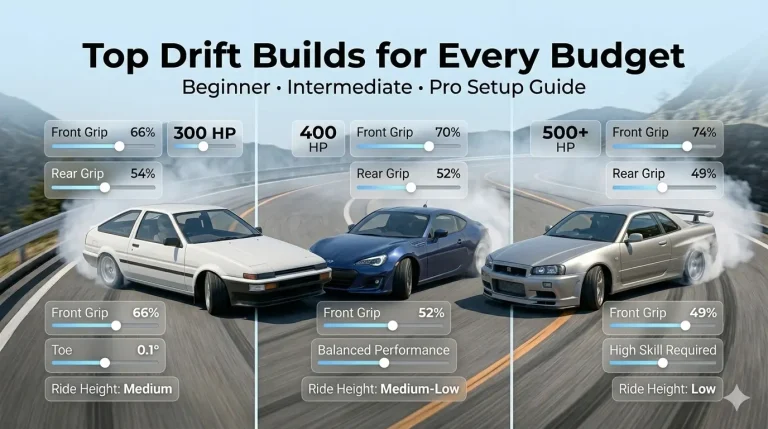
250–350 HP
Keep gearing a bit shorter to avoid bog; protect mid-corner drive
Lower-powered cars need shorter ratios to stay in their optimal power band. These engines produce peak torque in narrower RPM ranges than high-output builds.
Shorter gearing helps compensate for limited power by keeping you in the sweet spot more consistently. You can’t rely on raw power to overcome gearing mistakes.
Focus on maintaining momentum rather than generating massive wheel spin. Smooth, consistent power delivery matters more than peak output with these builds.
350–500 HP
Neutral final drive; trim 3rd for sector demands
Mid-range power builds offer the most flexibility in gearing options. These cars have enough torque to work with various ratio setups while still needing proper tuning.
Neutral final drives work well because you have enough power to overcome minor gearing inefficiencies. Fine-tune individual ratios based on specific track demands.
This power range works well with most FR Legends livery codes and tuning combinations. You have enough flexibility to prioritize style without sacrificing performance.
500+ HP
Slightly longer final drive to tame wheelspin; limit frantic 2→3 shifts
High-power builds need longer ratios to manage excessive wheelspin and maintain control. Too much power can actually hurt scores if you can’t control it properly.
Longer gearing helps you modulate throttle inputs more precisely. Small throttle changes have smaller effects on wheel spin and car behavior.
Reduce rapid gear changes that can upset high-powered cars. Smooth, deliberate inputs work better than aggressive driving techniques with these builds.
Shift Strategy for Consistent Scores
Plan shifts on straights, not mid-corner
Timing your shifts properly is crucial for maintaining consistent scores. Plan gear changes for straight sections between corners, never during active drift zones.
Mid-corner shifts upset your car’s balance and can cause sudden changes in power delivery. These disruptions often result in lost angle, reduced smoke, or complete spin-outs.
Map out your shift points during practice runs. Know exactly where you’ll change gears before you start your scoring run.
Use the clutch/handbrake to settle the car before a shift
Quick clutch kicks or handbrake taps can help settle your car before gear changes. These techniques prevent the jerky transitions that hurt drift scores.
Practice smooth shifting techniques in free practice before attempting scored runs. Develop muscle memory for clean transitions that don’t disrupt your drift flow.
The goal is to make gear changes invisible to your scoring system. Smooth transitions maintain consistent wheel spin and angle throughout your run.
Lead vs chase: keep pace predictable for tandems
Tandem runs require different shift strategies than solo runs. Lead drivers should maintain a predictable pace through consistent gear usage and smooth transitions.
Chase drivers need to match the leader’s rhythm, which might require different gearing than their preferred solo setup. Consider separate tandem presets for lead and chase roles.
Communication with your tandem partner helps both drivers choose appropriate gearing. Discuss preferred speeds and gear usage before starting tandem sessions.
Controller/Touch + Throttle Curve Pairing
Why softer throttle curves help long-gear stability
Softer throttle curves work better with longer gear ratios because they provide more precise control over power delivery. Small input changes create smaller power changes.
Linear or aggressive throttle curves can make long-geared cars feel sluggish or unpredictable. The delayed response between input and power delivery creates timing issues.
Experiment with different curve settings when you change your fr legends transmission ratios. What works with short gears might not work with longer setups.
Steering sensitivity that matches longer gearing
Longer gear ratios often work better with slightly reduced steering sensitivity. This combination creates smoother, more predictable car behavior during sustained drifts.
Quick steering inputs can overwhelm longer-geared cars and cause sudden direction changes that disrupt your drift flow. Smooth, progressive inputs work better.
Match your control sensitivity to your gearing philosophy. If you’re prioritizing smoothness in your ratios, apply the same approach to your control settings.
Handbrake taps vs long pulls with taller gearing
Taller gearing changes how you should use your handbrake for corrections and transitions. Quick taps work better than long pulls for maintaining momentum.
Long handbrake applications can cause excessive speed loss with longer ratios. You might not have enough power to quickly regain momentum and angle.
Practice handbrake techniques that complement your gearing choices. Different ratio setups require different correction techniques for optimal performance.
Troubleshooting Matrix
Use this quick reference guide to diagnose and fix common gearing problems:
| Symptom | Fix |
| Bouncing off the limiter mid-corner | Lengthen the final drive slightly |
| Car bogs on exit | Shorten the final drive or tighten the 2nd |
| Too many shifts per lap | Lengthen 2nd and 3rd a touch |
| Snappy on transitions | Reduce the 2nd’s aggression; consider a hair longer 3rd |
| Can’t hold long sweeper | Lengthen final drive; soften throttle curve |
| Wheelspin at exit despite power | Lengthen 2nd or adjust rear grip (from tire guide) |
Keep this troubleshooting matrix handy during tuning sessions. Most gearing problems fall into these common categories and have straightforward solutions.
Remember to change only one setting at a time when applying these fixes. Multiple simultaneous changes make it harder to identify which adjustment actually solved the problem.
Common Mistakes
Tuning 2nd/3rd before final drive
The biggest mistake new tuners make is adjusting individual gear ratios before setting the final drive properly. This backwards approach creates more problems than it solves.
Always establish your final drive first, then fine-tune individual ratios. This method is faster and produces more predictable results than trying to fix everything with gear-specific adjustments.
Copying ratios without matching power/track
Blindly copying setups from online sources rarely works well. Different power levels, tracks, and driving styles require different approaches to gearing.
Use shared setups as starting points, not final solutions. Adapt them to match your specific car, track, and skill level for optimal results.
Shifting mid-corner and blaming alignment
Poor shifting technique often gets blamed on suspension or alignment problems. If you’re shifting during active drift zones, fix your driving technique before adjusting other settings.
Practice holding single gears through entire sections. Many perceived car problems actually stem from unnecessary gear changes that disrupt drift flow.
Pro Tips for Tandems & Competitions
Build separate “Lead” and “Chase” gear presets
Leading and chasing in tandems require different approaches to gearing. Lead drivers prioritize consistency and predictable pace, while chase drivers need flexibility to match varying speeds.
Create dedicated presets for each role. Lead setups might emphasize steady power delivery, while chase setups might prioritize responsiveness for quick pace adjustments.
Match room pace: tiny final-drive changes keep proximity clean
Small final drive adjustments can help you match the room’s overall pace without major setup overhauls. One or two clicks can make the difference between clean tandems and constant spacing issues.
Monitor how your car’s pace compares to other drivers during practice. Make micro-adjustments to blend better with the group’s preferred speeds.
Save sector-named presets so you can swap fast in practice
Organize your presets with clear, descriptive names that indicate track type, main gear, and special notes. This system helps you quickly find the right setup during busy practice sessions.
Examples: “Tech_2nd_Short”, “Mixed_3rd_Neutral”, “Sweep_3rd_Long”. Clear naming prevents confusion and saves time during setup changes.You can find additional tuning resources and setups at frlegndsmodapk.com to complement your gearing knowledge with other performance modifications.
The key to mastering FR Legends gearing lies in understanding the principles rather than memorizing specific numbers. Every car and driver combination is unique, so use these guidelines as starting points for your own tuning journey.For more advanced tuning options, check out the FR Legends Supra mod, which offers additional customization possibilities for serious tuners.
FAQ’s
What are the best FR Legends gear ratios for beginners?
Use mixed presets with 3rd gear dominance and neutral final drive. This setup is stable and forgiving while you learn drifting basics.
Should I set final drive or individual ratios first?
Always adjust final drive first since it affects all gears together. Then fine-tune individual ratios for better control.
Is 2nd or 3rd gear more stable on most tracks?
3rd gear is usually more stable and balanced for most tracks. Use 2nd gear only on tight, technical circuits.
How can I avoid hitting the limiter in FR Legends?
Lengthen the final drive slightly. If limiter bounce continues, soften the throttle curve to smooth power delivery.
Do I need to change gear ratios when I change power?
Yes. Higher power requires longer ratios, while lower power works better with shorter ratios.
Are different gear setups needed for tandems?
Yes. Use stable, consistent gearing when leading, and a more responsive setup when chasing to match the leader’s pace.